
Neuroscience
The Silver Lab studies information processing and learning in neuronal circuits by combining experimental approaches with quantitative analysis methods and computer modelling.
Summary of neuroscience research
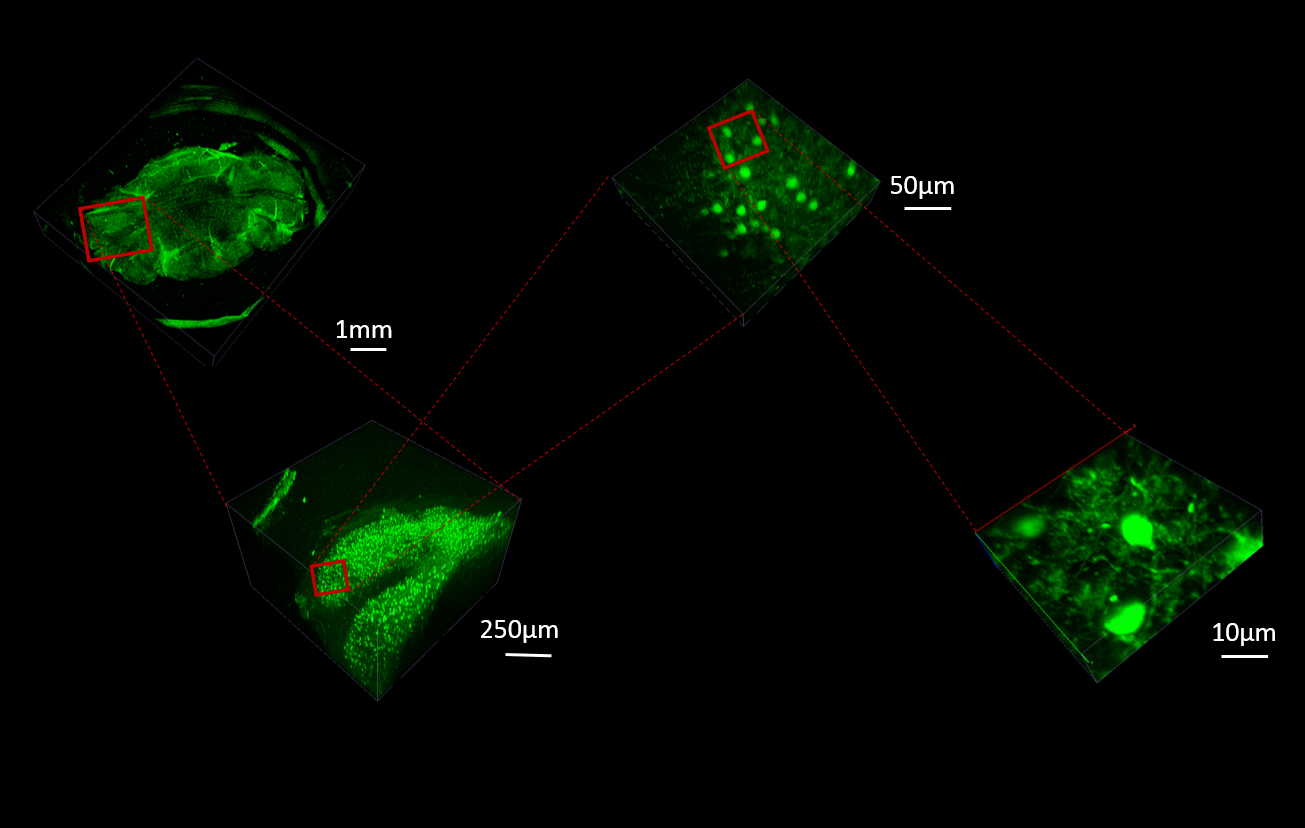
Our research focuses on how neural systems represent and process sensory and motor information and how sensorimotor associations are formed. To do this we investigate information processing in neural circuits in the cerebellum and neocortex during behavior. At the network level, we study how the activity of populations of excitatory and inhibitory cells within local circuits encode behavioral parameters and how these representations change during reward-based learning. We use state space and regression methods to analyze neural population data and relate it to behavior. At the cellular level, we investigate how synaptic and dendritic properties of neurons shape the mathematical operations that they perform on incoming signals. While at the finest spatial scale we study synaptic transmission, since this ultimately sets the rate at which information can be transmitted from one neuron to the next. We take a highly multidisciplinary approach to investigate these questions, combining cutting-edge 3D acoustic-optic lens two photon microscopy (3D-AOLM) and opto-/chemo-genetic methods with behavioral tasks, together with in vitro electrophysiological methods and mathematical modelling. This enables us to link the multidimensional properties of population codes to network structure and the underlying neuronal and synaptic mechanisms, thereby providing a multiscale understanding of sensorimotor processing and learning in neocortical and cerebellar circuits.
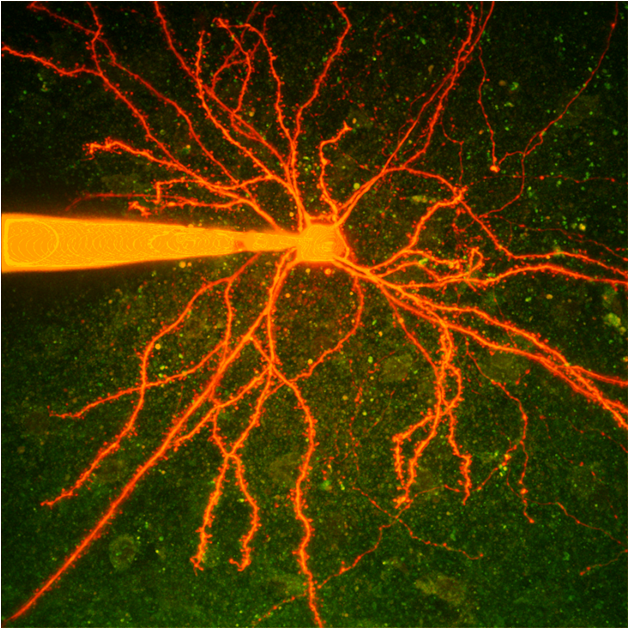
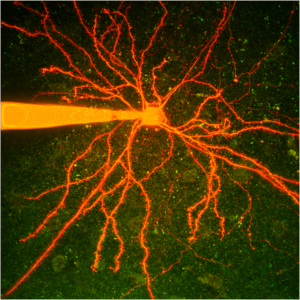
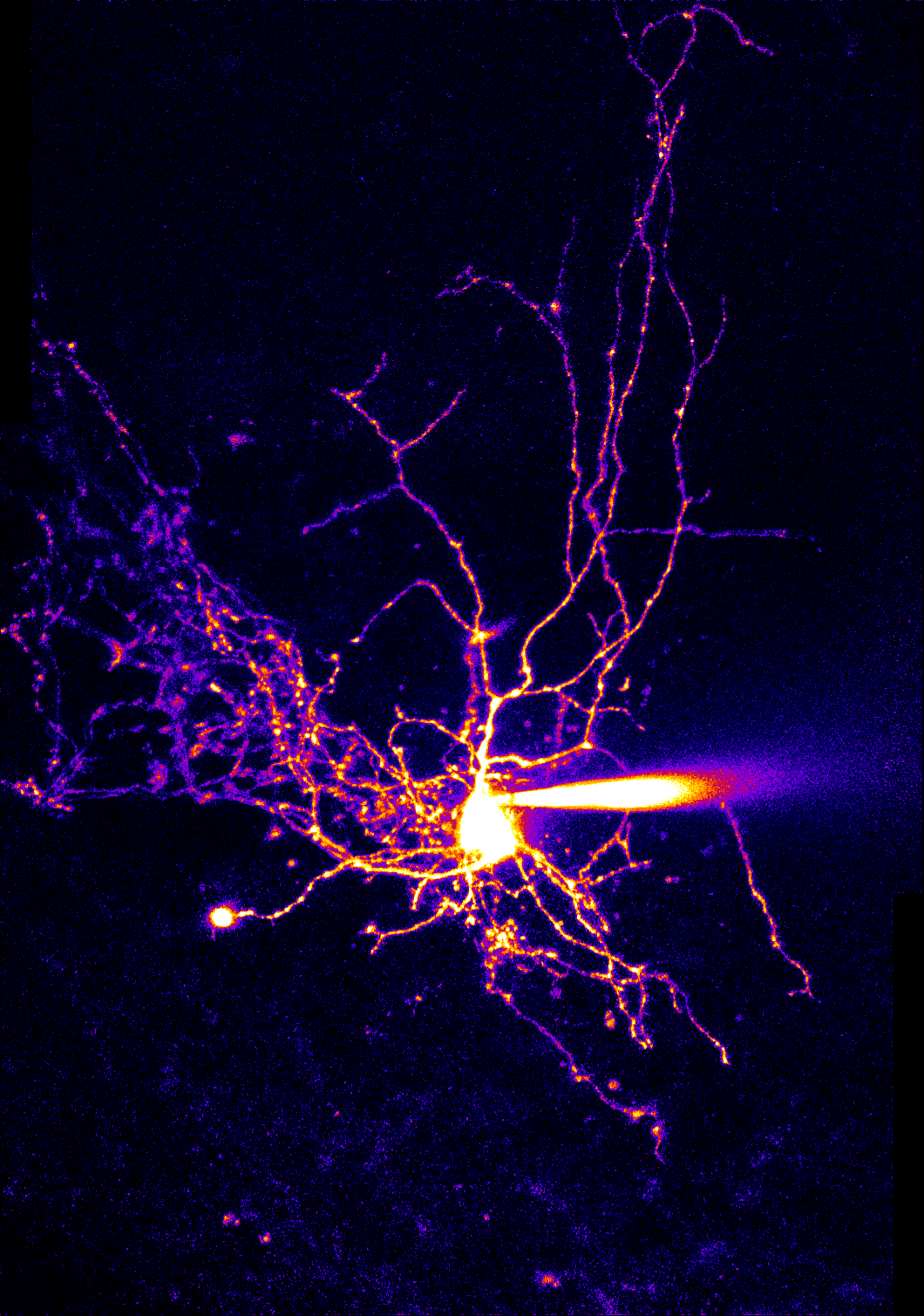
Two-photon maximum intensity projection image of a Layer 4 star pyramidal cell of the Barrel Cortex filled with Alexa-594.
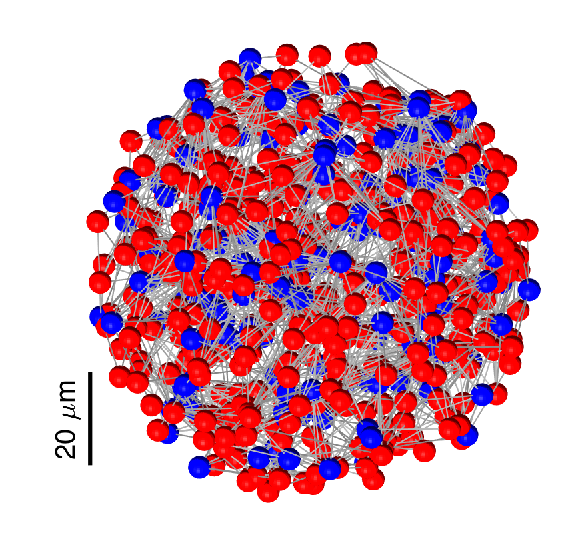
Anatomically constrained model used in simulations of cerebellar granular layer, showing positions of and connectivity between mossy fibre rosettes (blue) and granule cells (red).
Structure and function of excitatory circuits
We study excitatory circuit function by combining measurements of population activity recorded with high speed 3D-AOLM during behavioral tasks with computational models that link the circuit properties to the underlying synaptic connectivity and cellular properties. Our recent work has focused on the main cellular components of the cerebellar input layer. We have shown that cerebellar granule cells can support high dimensional representations of behavior and that their population codes have several features in common with those in neocortex, raising the possibility that neocortical and cerebellar processing is more tightly interlinked that previously envisaged (Lanore et al., Nature Neuroscience, 2021). We are currently extending these studies to examine the population-level properties of mossy fibres, which convey sensorimotor information to the cerebellar cortex. To understand how circuit structure and function are linked we build biologically detailed network models that are based on biophysical and anatomical measurements. This approach showed that the synaptic connectivity of feedforward networks governs the trade-off between information transmission and the network’s ability to form a sparse code (Billings et al., Neuron 2014). Moreover, we showed that the synaptic connectivity between mossy fibres and granule cells is optimal for separating overlapping activity patterns, which aids associative learning (Cayco-Gajic et al., Nature Communications 2017; Neuron 2019). These theoretical studies suggest that the anatomical structure of the cerebellar input layer network is optimal for performing pattern separation signals without information loss. They also provide a functional explanation for why cerebellar granule cells, which make up over half of the neurons in the vertebrate brain, have approximately 4 synaptic inputs (a morphology that has been evolutionarily conserved since the appearance of fish). To close the theory-experiment loop, we are currently testing our model-based predictions and long-established pattern separation theories of the cerebellar input layer.
Inhibitory interneuron circuits
Inhibitory interneurons play a key role in information processing by controlling the input-output relationship of individual neurons and orchestrating spatio-temporal patterns of activity at the network level. Golgi cells, which are the main inhibitory interneuron in the input layer of the cerebellum, are a major focus of research in the SilverLab. Our studies of these electrically coupled interneurons have led to three main discoveries: 1) Electrical synapses between Golgi cells can mediate inhibition; 2) Sparse synaptic excitation can desynchronise electrically coupled interneuron networks (Vervaeke et al., Neuron 2010); 3) By sharing charge arising from chemical synaptic inputs across the dendrites of neighboring cells, dendritic gap junctions enhance the sensitivity of inhibitory networks to synaptic excitation and counteract sublinear dendritic integration (Vervaeke et al., Science 2012). More recently, we have quantified the biophysical properties of dendritic gap junctions formed between Golgi cells (Szoboszlay et al., Neuron, 2016). Our in vivo imaging of local populations of Golgi cells has revealed that their activity is highly correlated on slow timescales, but that subgroups of cells exhibit distinct behaviors on faster timescales (Gurnani and Silver, Neuron 2021). Our model of the Golgi cell circuit (constrained by our earlier biophysical measurements) reproduces the population level properties and shows that electrical coupling between Golgi cells plays a key role in determining the distinct properties of Golgi cell population activity. These results suggest that Golgi cell circuit properties are well suited for delivering the inhibition required for gain modulation and temporal processing in downstream granule cells.
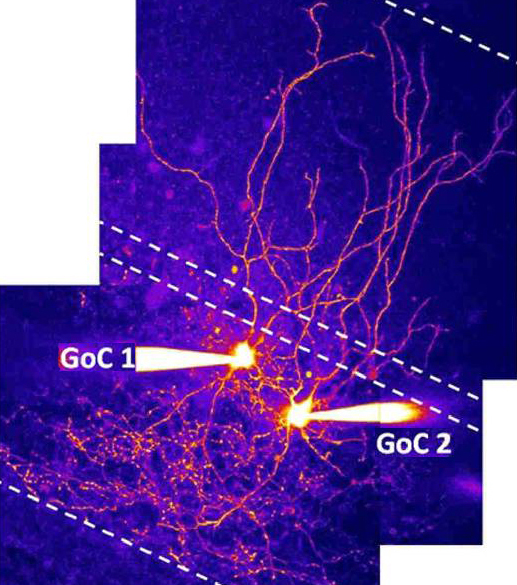
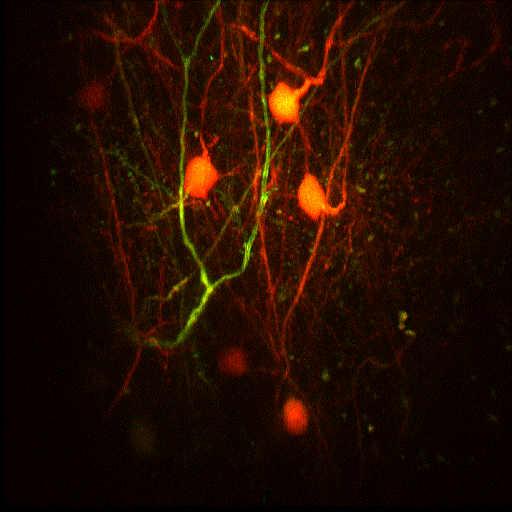
Paired patch-clamp recordings from inhibitory cerebellar Golgi cells.
Neural computation
At the cellular level we study how individual neurons transform synaptic input into spiking output. We showed that inhibition can perform neuronal gain modulation, allowing rate-coded synaptic signals to be multiplicatively scaled (Mitchell and Silver, Neuron 2003). The mathematical operations performed by inhibition depend on the properties of excitatory synaptic input, because short-term depression converts additive operations into multiplicative operations (Rothman et al., Nature 2009). These discoveries have identified some of the most basic and ubiquitous mechanisms that neurons use to perform arithmetic operations. Our current work focusses on dendritic integration in neocortical pyramidal cells. We are using 3D-AOLM to image the entire dendritic trees of L2/3 cells expressing GCaMP6f during spontaneous behaviors and visual stimuli. These multiscale recordings capture the spatiotemporal patterns of synaptic input onto the dendritic tree, the branch activation patterns and the activity of the neighboring cells in local neocortical circuits. These new data will enable us to link synaptic, neuronal and circuit level representations of visual stimuli and behavioral variables in neocortical circuits.
Synaptic transmission
Synaptic transmission is a core interest of the SilverLab. Our development and application of Multiple-Probability Fluctuation Analysis (also known as variance-mean analysis) has enabled us to identify the quantal properties and mechanisms underlying the diverse functional properties of central synapses (Saviane and Silver, Nature 2006; Silver et al., J. Physiol. 1998; Silver et al. Science 2003). The discovery that cerebellar mossy fibre-granule cell synapses can operate over a much wider frequency bandwidth than thought possible for central synapses led us to identify a number of key pre- and postsynaptic adaptations that enable high fidelity signalling. These include a large resource of vesicles (300 per release site) and that vesicles can be translocated, docked and primed much faster than previously thought possible at central synapses (Saviane and Silver, Nature 2006; Hallermann et al., Neuron 2010). Our more recent study of vesicle mobility suggests that hydrodynamic interactions between vesicles plays a key role in setting their mobility and the supply rate to the active zone (Rothman et al., eLife 2016). On the postsynaptic side we showed that synaptic AMPARs are more resistant to desensitization than previously thought, allowing them to convert glutamate that spills over from neighboring release sites into current, without desensitizing (DiGregorio et al., Neuron 2002; J. Neurosci 2007). These discoveries explain how sensory signals are streamed with high fidelity to the cerebellum (Arenz et al., Science 2008) and establish the performance of some central synapses is comparable to peripheral ribbon-type synapses. In collaborative work at the giant Calyx of Held synapse we established that presynaptic Ca2+ channels are clustered at active zones and that vesicles are released at the cluster perimeter (Nakamura et al., Neuron 2015). The perimeter release model can account for the changes in vesicular release during development and explains how temporally precise synaptic signaling is maintained over a wide range of release probabilities.
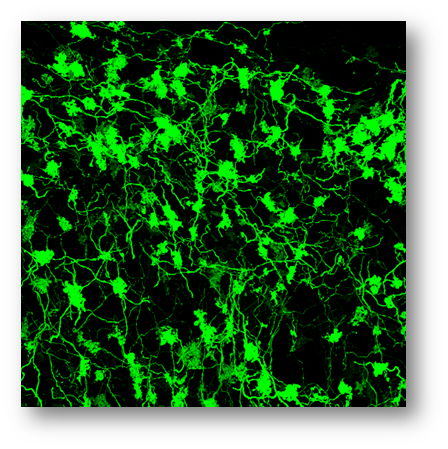
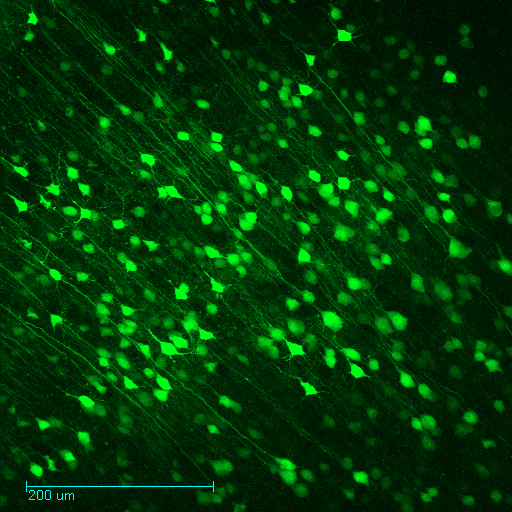
Image of mossy fibres in the input layer of the cerebellar cortex.
Research supported by: